
Chimney & Flue Smoke Testing
Identify Chimney Leaks, Flue Defects, and Draft Issues with a Smoke Test
Chimney & flue smoke testing is a professional diagnostic process used to evaluate the integrity, airflow, and leak pathways of venting systems — including the flue liner, appliance connections, and chimney structure. Rather than assessing only the visible chimney exterior, this method tests the entire vertical venting pathway as a unified system.
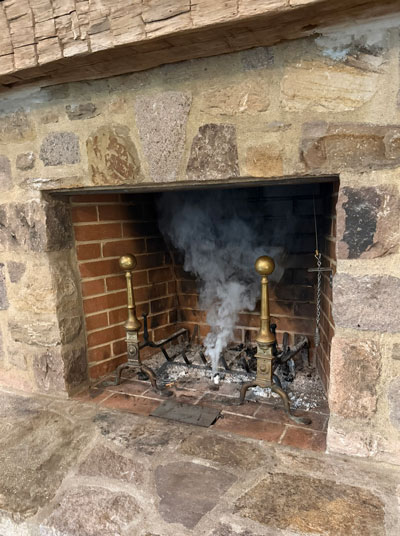
By introducing dense, visible smoke into the flue, technicians can observe where smoke escapes through cracks, failed joints, liner defects, or hidden breaches. Because the flue and chimney function together as one venting assembly, smoke testing provides a comprehensive assessment of both internal flue integrity and external chimney performance in a single procedure.
This controlled, visual method allows professionals to quickly identify:
- Cracked or deteriorated flue liners
- Chimney masonry leaks and joint failures
- Hidden defects inside walls or cavities
- Improper appliance-to-flue connections
- Draft restrictions and airflow imbalances
Unlike invasive inspection methods or limited visual checks, chimney & flue smoke testing reveals real-world system behavior under natural airflow conditions, making it one of the most reliable ways to diagnose venting defects.
Chimney & Flue Applications
Flue Integrity Testing
Verify that the internal flue liner is continuous, sealed, and free of cracks, separations, or deterioration that could compromise venting performance.
Chimney Leak Detection
Identify structural leakage along masonry, joints, flashing transitions, and exterior chimney surfaces where smoke escapes.
Draft & Venting Diagnostics
Evaluate natural draft behavior and detect airflow disruptions, or improper vent routing that affect appliance performance.
Appliance Vent Connection Verification
Confirm that fireplaces, furnaces, boilers, and other vented appliances are properly connected to the flue system without leakage.
Post-Repair and Relining Verification
Validate chimney relining, sealing, or structural repairs by confirming full system integrity from the appliance connection through the flue and chimney stack.
Blowfish Encased Smoke Pellets

Blowfish Encased Smoke Pellets provide a controlled, professional-grade smoke source specifically suited for chimney and flue diagnostics. They generate the proper smoke volume needed to visibly track airflow and reveal even minor leakage points along both the internal flue pathway and the chimney structure.
Designed for straightforward field use, they ignite quickly, deploy easily without complex equipment, and deliver consistent, highly visible smoke output that supports accurate, repeatable testing. Their compact format and low cost also make them an efficient and inexpensive solution for routine chimney and flue integrity checks, draft diagnostics, and post-repair verification without the need for larger smoke-generating systems.
Chimney & Flue Smoke Testing Procedure

Because chimney and flue smoke testing is used across a wide range of applications—fireplaces, inserts, furnaces, boilers, commercial venting systems, etc —there is no single, one-size-fits-all procedure. Smoke testing is generally best performed by trained professionals who understand venting systems and how to interpret smoke movement accurately.
General best practices include:
- Notify occupants prior to the smoke test to prevent unnecessary concern.
- Ensure the fireplace or appliance being tested is off / not in use.
- Close all doors and windows in the area of the appliance to simulate a “worse case scenario.”
- Preheat the flu. This can be accomplished with a propane torch, heat gun, or small kindling fire depending on the application.
- Introduce smoke at, or close to, the origin of the venting pathway (such as in the appliance or primary flue entry) so the smoke travels the full venting pathway, allowing the entire path to be evaluated for leaks, defects, and airflow behavior.
- Observe attic spaces, wall cavities, and exterior chimney surfaces for smoke escape.
- Verify smoke is exiting from a single flue – smoke exiting from two or more adjacent flues indicates both flues have internal defects and should be relined.
- Account for weather conditions, wind, and draft variability that may influence results.
The goal of chimney and flue smoke testing is to observe how smoke naturally travels through the complete venting pathway under normal draft conditions. When introduced properly, the smoke will follow the same path that exhaust gases would take, escaping at any defects, breaches, or leakage points along the flue liner or chimney structure. The focus should always be on clear visual diagnostics and realistic system behavior, rather than forcing airflow or overloading the system with excessive smoke.
Ready to Start Smoke Testing?
Browse our selection of professional-grade smoke pellets—engineered for consistent, visible output and dependable performance across a wide range of applications. Trusted by professionals, they deliver the reliable results you expect on every job.

90-Second Encased Smoke Pellets

